
 EN

Long-Duration Energy Storage: When Hydrogen Should Enter the Options Review
For renewable-energy project teams, long duration energy storage is not one technology decision. It is a planning question: how long must energy remain available, how often will the asset cycle, and what service must it provide when renewable output falls? Hydrogen should enter the options review when those answers point beyond daily shifting toward multi-day resilience, infrequent deep discharge, or seasonal balancing.
The U.S. Department of Energy describes long duration energy storage as storage able to deliver electricity for 10 hours or more. That threshold is useful for scoping, but it is not an automatic reason to choose hydrogen. A project needing 10 to 16 hours every day may reach a different conclusion from one that needs dispatch across several low-renewable days. The useful comparison starts with the operating problem, not with a preferred technology.
Start With the Energy Gap, Not the Equipment
Map the gap the system must cover before comparing technologies. Record the required power, the total energy needed, the duration of each event, the number of events per year, and the acceptable recovery time between them. A battery-oriented solution may be a good fit when the same discharge window repeats daily. Hydrogen deserves a closer look when the energy gap becomes long, irregular, or tied to weather patterns that can persist for days.
For example, a site may need backup power during rare grid interruptions, renewable curtailment capture during selected months, or firm output through a prolonged wind-and-solar shortfall. In these cases, increasing stored energy can matter more than maximizing cycle efficiency alone. The DOE’s hydrogen LDES discussion considers storage from 12 hours up to 7 days and explains duration as continuous, full-rated output from a fully charged system. Use that definition to make the duty cycle explicit in every option review.
Signals That Hydrogen Belongs in a Long Duration Energy Storage Review
Add hydrogen to a long duration energy storage shortlist when several of the following conditions apply:
- Multi-day or seasonal energy shifting is plausible. The project must retain energy beyond a routine overnight or daily dispatch window.
- Long storage time matters more than frequent cycling. The asset may sit charged for extended periods and discharge during exceptional events or low-generation intervals.
- Power and energy capacity need separate scaling decisions. The project team needs to assess electrolyzer capacity, hydrogen storage quantity, and reconversion capacity as related but distinct design choices.
- There is usable low-carbon electricity for charging. A credible supply profile for surplus renewable electricity is essential to the system concept.
- Site and operations planning can accommodate the full pathway. The review can address water, compression or storage method, safety engineering, controls, maintenance, and reconversion equipment.
These signals do not prove that hydrogen is the selected answer. They justify evaluating it alongside other long duration energy storage approaches so the team does not rule out a pathway simply because the first comparison focused on daily cycling.
Where Hydrogen May Be a Poor First Fit
Hydrogen is not automatically the right option for every renewable energy storage system. If the operating case calls for predictable, high-frequency, short-duration dispatch, a team should first test solutions designed around that pattern. Likewise, a review is incomplete if it counts only stored hydrogen and ignores the energy required for electrolysis, storage conditioning, and electricity reconversion.
Be cautious when the project has no defined charging source, no practical site concept for storage and safety systems, or no clear use for energy beyond a short, recurring peak. These are not reasons to dismiss hydrogen permanently; they are reasons to refine the need statement before requesting supplier proposals.
Compare the Whole System Boundary
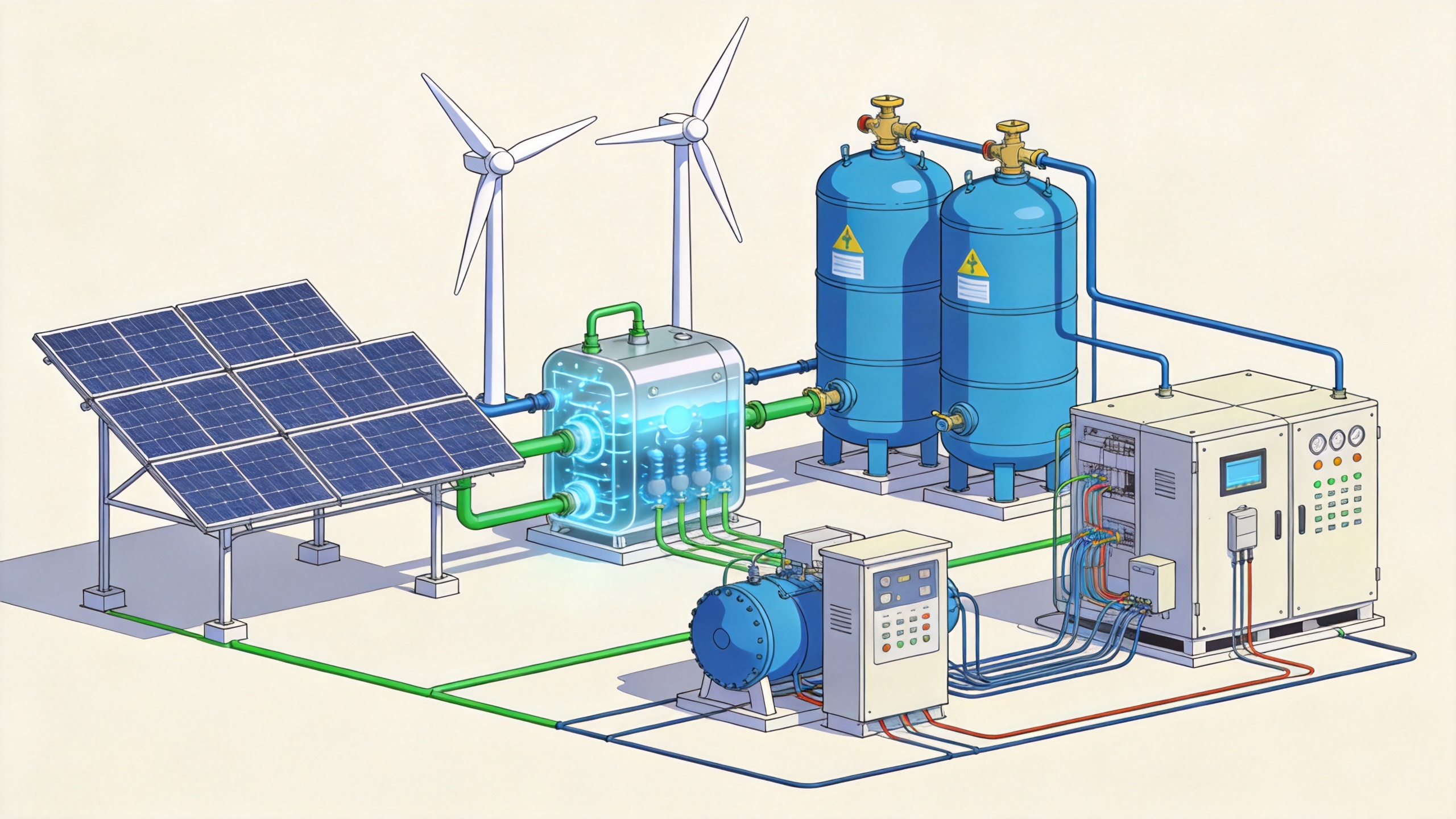
A dependable long duration energy storage comparison uses one common boundary for every option. For hydrogen, include the electricity input, electrolyzer, water treatment where relevant, storage method, power conversion or end-use equipment, controls, interconnection, safety design, and operating plan. Separating these elements helps procurement teams avoid comparing a complete system on one side with a partial subsystem on the other.
| Question | Why it changes the review |
|---|---|
| What is the required power during discharge? | It shapes the reconversion or end-use capacity requirement. |
| How many hours or days must energy be available? | It establishes the energy inventory and storage-duration case. |
| How often will the system cycle? | It distinguishes daily shifting from resilience or seasonal use. |
| What renewable electricity is available for charging? | It tests whether the charging profile supports the intended operating model. |
| What site constraints apply? | It brings storage approach, safety engineering, utilities, and logistics into the same decision. |
Questions to Ask a Hydrogen Storage Supplier
Once hydrogen is in scope, ask suppliers for information that allows like-for-like comparison rather than a headline claim. Request a proposed system boundary, the assumed charging profile, the defined discharge duty cycle, the storage approach, interfaces with power equipment, site requirements, safety documentation, controls philosophy, maintenance assumptions, and the data needed to model annual operation.
For teams exploring a metal-hydride-based route, the product discussion should still begin with the site’s load and duration. Hyto Energy’s Mega hydrogen storage unit can be evaluated as part of that broader system conversation. Ask how the proposed storage unit interfaces with the hydrogen source and the intended energy-use equipment; do not infer performance, approvals, or project fit from a product name alone.
Move From a Technology Debate to a Decision Brief
The practical output of an early long duration energy storage review is a decision brief, not a winner announced too soon. State the duration cases to be tested, the charge-energy assumptions, the discharge services, the cycling pattern, the site constraints, and the evidence each supplier must provide. Then compare candidates against the same operating cases.
Hydrogen should enter the review when a project has a credible need to hold renewable energy over long, uneven, or seasonal intervals and can assess the full conversion-and-storage pathway. If the need is mainly daily and repeatable, keep the comparison anchored to that reality. Either way, a clearly defined duty cycle gives engineering, procurement, and suppliers a more useful starting point for evaluating a renewable energy storage system.