
 EN
EN

How Hydrogen Microgrids Support Off-Grid Power Systems
Off-grid sites need electricity that can keep working when utility access is unavailable, unreliable, or too costly to extend. Solar and wind can provide low-carbon energy, but their output changes with weather and time of day. This is where power generation from hydrogen can add a useful layer of resilience. In a hydrogen microgrid, surplus renewable electricity can support hydrogen production and storage, then stored hydrogen can be converted back into electricity when renewable output is insufficient.
A hydrogen microgrid is not simply a fuel cell added to a solar array. It is a coordinated system of generation, storage, conversion, controls, and loads. From a microgrid-planning perspective, the important question is how these elements work together over hours, days, or longer periods—not which component appears most suitable in isolation.
What a hydrogen microgrid does in an off-grid system
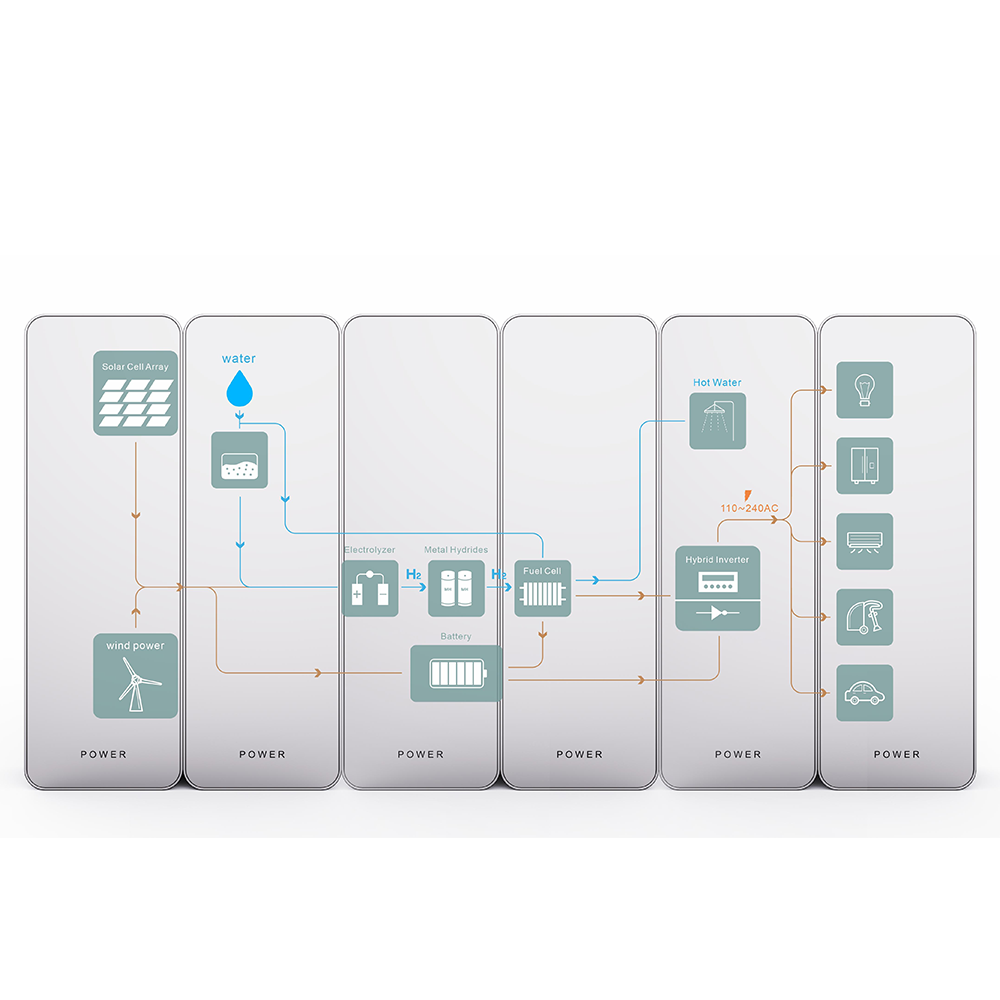
At its core, power generation from hydrogen gives an off-grid system another way to dispatch stored energy. A typical arrangement combines renewable generation, power electronics, an electrolyzer or external hydrogen supply, hydrogen storage, a fuel cell or other generation unit, a battery, and an energy-management system.
When renewable output exceeds immediate demand, the controller can charge batteries first or allocate energy to hydrogen production, depending on the operating strategy. When solar or wind output falls, batteries may cover short fluctuations while the hydrogen power unit supports longer-duration demand. Dispatch means deciding when stored hydrogen is converted into usable electricity. That distinction matters because batteries and hydrogen storage do not solve exactly the same problem.
Fuel cells generate electricity through an electrochemical reaction between hydrogen and oxygen. In an off-grid microgrid, that conversion can be controlled to support critical loads such as communications equipment, remote monitoring, water-treatment systems, field facilities, or isolated industrial operations. The appropriate configuration still depends on the actual load profile, required autonomy, hydrogen availability, and local safety requirements.
The system components behind power generation from hydrogen
A practical hydrogen microgrid starts with an energy balance. Designers need to define average demand, peak demand, seasonal variation, critical-load priority, and the duration of expected low-renewable periods. It may be tempting to size the system around the headline load, although the duty cycle needs confirmation.
- Renewable generation: solar, wind, or a hybrid source provides variable input energy.
- Battery storage: handles fast response, power quality, and short-duration balancing.
- Hydrogen production or supply: provides the fuel pathway for longer-duration energy storage.
- Hydrogen storage: holds energy in a form that can be retained beyond a typical daily battery cycle.
- Fuel-cell power generation: converts stored hydrogen into electricity when the controller calls for it.
- Microgrid controls: coordinate generation, charging, conversion, load shedding, alarms, and operating limits.
The key design insight is that power generation from hydrogen is part of a chain. A change in storage capacity, fuel-cell output, electrolyzer operating window, or critical-load schedule can affect the whole chain. Before comparing components, document the system boundary and the expected operating sequence.
Why hydrogen can complement batteries for long-duration resilience
Batteries are often effective for rapid response and frequent cycling. Hydrogen can be considered when an off-grid application needs energy to be held for longer intervals, when renewable production is highly seasonal, or when reducing dependence on diesel is a project objective. More storage flexibility can improve resilience, while adding system complexity that must be verified.
For example, a remote site may see strong renewable generation during some periods and extended low-output conditions during others. A battery-only design may be appropriate if the autonomy requirement is short. A hybrid battery-and-hydrogen design may be worth evaluating if the project requires longer backup duration or needs a different energy-storage pathway. This is a planning comparison, not a universal recommendation: the right answer depends on demand, logistics, available space, operating staff, and lifecycle economics.
Research results on hydrogen-to-electricity pathways can vary by technology and system boundary. One published combined-cycle context reported about 38% real efficiency for a renewable-electricity-to-hydrogen-to-electricity route; that figure should not be treated as a universal microgrid performance number. For an individual site, measured operating assumptions and supplier documentation are more useful than applying a generic headline figure.
Where off-grid hydrogen microgrids may fit
Hydrogen microgrids can be relevant where energy resilience and long-duration storage need to be considered together. Common planning scenarios include remote industrial sites, telecom infrastructure, research locations, islanded facilities, temporary field operations, and community services with critical loads. What happens to the design if the required power duration changes from a few hours to several days? That question often reveals whether a hybrid architecture deserves further study.
For organizations exploring an integrated pathway, a hydrogen microgrid integrated solution can provide a starting point for discussing system interfaces. The site-specific design still needs to establish real load data, hydrogen handling requirements, control logic, and commissioning responsibilities before any outcome can be assumed.
A first-pass checklist for project teams
- Map hourly, daily, and seasonal load behavior, separating critical from deferrable loads.
- Estimate renewable resource variability and the realistic generation window.
- Define the required autonomy period and acceptable service interruptions.
- Compare battery-only, hydrogen-only, and hybrid operating concepts against the same assumptions.
- Confirm hydrogen production, delivery, storage, ventilation, detection, and emergency-response requirements.
- Specify how the controller will prioritize batteries, hydrogen conversion, renewable curtailment, and load shedding.
- Request verified performance curves, operating limits, maintenance plans, and applicable compliance evidence from potential suppliers.
How to evaluate power generation from hydrogen before selecting equipment
Before selecting equipment, project teams should test power generation from hydrogen against a defined operating case. Start with the electrical demand that must be served, then describe the renewable resource, the expected low-generation period, and the permitted recovery time. This turns power generation from hydrogen from a broad energy concept into a measurable system question.
Next, identify the role of each asset. Batteries can stabilize short-term changes; fuel-cell power generation from hydrogen can be scheduled for longer support periods; the controller can preserve hydrogen for critical loads when forecast renewable output is limited. The resulting control philosophy should be reviewed alongside the physical equipment. A larger storage vessel alone does not demonstrate that power generation from hydrogen will meet the site's service requirement.
Finally, ask suppliers to validate assumptions with site-specific documentation: electrical output range, ramp behavior, fuel-quality requirements, maintenance intervals, environmental limits, and safety interfaces. These checks help determine whether power generation from hydrogen is compatible with the intended microgrid rather than merely technically possible.
Making the role of hydrogen clear
For awareness-stage planning, the value of power generation from hydrogen is not that it replaces every other energy asset. Its value is that it can extend the design space for off-grid power systems. Hydrogen can connect variable renewable generation with longer-duration energy storage and controllable electricity supply, while batteries continue to serve fast-response roles.
A sound hydrogen microgrid concept begins with operating conditions, not equipment claims. Define the load, renewable input, storage duration, safety boundaries, and control strategy first. Then evaluate whether power generation from hydrogen offers a workable resilience pathway for the site.