
 EN
EN

What Is Solid-State Hydrogen Storage and How Does It Work?
Hydrogen can carry energy without producing carbon dioxide at the point of use, yet storing a very light gas is an engineering challenge. Hydrogen in solid state describes a family of storage approaches in which hydrogen is held within a solid material instead of only as a high-pressure gas or a cryogenic liquid. For B2B energy teams, the practical question is not whether hydrogen literally freezes. It is whether a material-based system can store and release hydrogen in a controlled, usable way for the application.
This distinction matters. Cryogenic solid hydrogen is elemental hydrogen cooled to an extremely low temperature. In contrast, most commercial discussions of solid-state hydrogen storage focus on materials—especially metal hydrides and other porous or chemical hosts—that reversibly take up hydrogen and later give it back. The storage medium, reactor design, heat flow, and operating profile must all be evaluated together.
What Does Hydrogen in Solid State Mean?
In a material-based system, hydrogen in solid state is stored through an interaction with a solid host. Depending on the material, hydrogen may occupy sites in a metal lattice, bind chemically, or be held on internal surfaces and pores. The material is placed in a vessel designed to manage gas flow and heat transfer.
Metal hydrides are a common example. A suitable alloy can react reversibly with hydrogen to form a hydride. The hydrogen is not simply compressed into empty space; it is incorporated into the material structure. That is why the design conversation must include material capacity, reaction temperature, equilibrium pressure, cycling behavior, and thermal management—not just vessel volume.
How the Storage and Release Cycle Works
The working cycle for hydrogen in solid state has two linked stages:
- Charging (absorption): Hydrogen enters the storage unit at the required pressure and contacts the active material. The material absorbs hydrogen and forms a hydrogen-rich state. For many metal-hydride systems, this reaction releases heat.
- Discharging (desorption): When downstream equipment needs fuel, the system changes temperature and/or pressure conditions so the material releases hydrogen. This step commonly requires heat input because reversing the reaction is endothermic.
In other words, a solid-state unit is also a thermal system. If heat cannot leave the bed during absorption, charging can slow down. If adequate heat is not supplied during desorption, the hydrogen delivery rate can fall. Engineers therefore consider heat exchangers, coolant loops, operating duty cycles, ambient conditions, and the heat available from connected equipment.
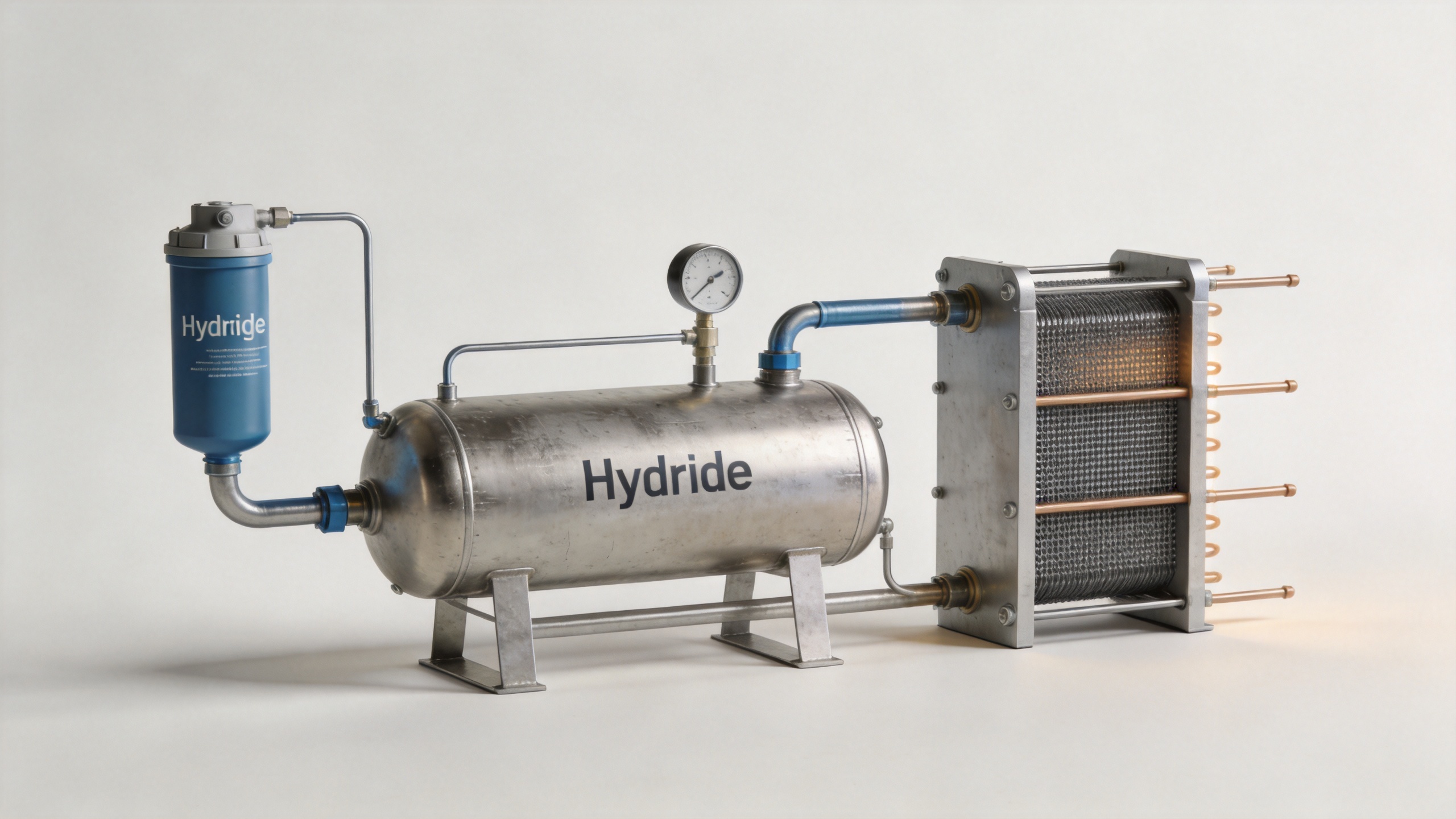
Materials Used for Solid-State Hydrogen Storage
No single material suits every project. The choice depends on the desired hydrogen flow rate, allowable temperature window, footprint, mass limits, safety objectives, cost, and expected number of cycles.
- Metal hydrides: Alloys can absorb hydrogen into their crystal structures and release it under controlled conditions. They are often evaluated where compact, lower-pressure storage and repeatable stationary operation are important.
- Complex hydrides: These compounds can offer high theoretical hydrogen content, but their release pathways, reversibility, and temperature requirements need careful validation.
- Porous adsorbents: Materials such as advanced porous frameworks can hold hydrogen on large internal surface areas. Their practical performance is sensitive to temperature and pressure.
- Carbon-based materials: These are studied for adsorption-based storage, with performance depending on pore structure and operating conditions.
Material data sheets are only a starting point. A useful procurement review asks how the material performs once it is packaged into a reactor with valves, sensors, heat exchangers, controls, and safety hardware. System-level usable capacity can differ substantially from a material’s theoretical figure.
Why Heat and Pressure Control Are Central
For hydrogen in solid state, pressure and temperature determine when hydrogen moves into or out of the host material. Published reviews describe many metal-hydride systems operating across broad ranges—often around 1–20 bar and 20–300°C—while stressing that the correct range depends on the specific alloy and system architecture. These values should be treated as design context, not a universal specification.
During absorption, removing reaction heat helps maintain favorable conditions for continued uptake. During release, a heat source may be needed to sustain the required flow. This link between storage and heat integration can be an advantage in stationary energy systems where recoverable waste heat is available, but it must be modeled during project design.
Where Solid-State Storage Fits in an Energy System
Solid-state storage can be considered for backup power, renewable-energy buffering, microgrids, laboratory and pilot systems, and hydrogen supply points where the operating profile aligns with the chosen material. It is not automatically the right solution for every mobile or high-throughput use case. Weight, response time, refueling speed, temperature management, and delivered hydrogen pressure all matter.
For an integrated project, the storage unit should be assessed alongside the electrolyzer, compressor or conditioning equipment, fuel cell or other end use, controls, ventilation, and site safety plan. A Medium hydrogen storage unit can be a relevant starting point for discussing storage-system configuration, but final suitability should be confirmed against the required capacity, duty cycle, hydrogen purity, and thermal conditions.
Benefits and Trade-Offs to Evaluate
The potential appeal of hydrogen in solid state is that the hydrogen is retained by a material rather than relying solely on a very high-pressure gas volume. Depending on the material and design, this may support compact layouts and lower operating pressures. Solid-state concepts can also offer a controlled, modular storage pathway for selected stationary applications.
However, the trade-offs are real. Storage media add mass, reaction kinetics can constrain charge and discharge rates, and heat management adds components and engineering work. Materials may also change over repeated cycles. A technically sound comparison therefore considers usable capacity, hydrogen delivery rate, charging time, operating temperature, energy needed for thermal control, maintenance, lifecycle behavior, and total installed cost.
A Practical Evaluation Checklist
- Define the usable hydrogen quantity and required delivery flow, not only nominal capacity.
- Map the charging and discharge duty cycle, including seasonal ambient conditions.
- Identify available heat sinks during absorption and heat sources during desorption.
- Confirm the material’s operating pressure-temperature window and cycling data.
- Evaluate system-level mass, footprint, controls, safety design, and service access.
- Verify compatibility with the upstream hydrogen source and downstream fuel-cell, industrial, or microgrid equipment.
Frequently Asked Questions About Hydrogen in Solid State
Is hydrogen in solid state the same as frozen hydrogen?
No. In most engineering discussions, hydrogen in solid state means hydrogen retained by a storage material. Hydrogen in solid state can refer to a metal hydride or another solid host; it does not necessarily mean cryogenic frozen hydrogen.
Why is hydrogen in solid state paired with thermal management?
Hydrogen in solid state changes the storage problem into a gas-and-heat problem. When hydrogen in solid state is charged into many hydride materials, heat must be removed. When hydrogen in solid state is released, heat may need to be supplied.
Can hydrogen in solid state support stationary clean-energy projects?
Hydrogen in solid state can be considered for stationary projects when the required capacity, flow rate, footprint, and available heat sources match the selected material. Hydrogen in solid state should be engineered as part of the wider production, storage, and end-use system.
What should a buyer ask before selecting hydrogen in solid state equipment?
Ask for usable capacity, delivery rate, charging conditions, release conditions, cycle data, heat-duty assumptions, controls, maintenance needs, and site-integration requirements. A hydrogen in solid state solution should be assessed using verified system data rather than a theoretical material figure alone.
Can hydrogen in solid state offer safety advantages versus compressed gas?
Safety depends on the material, vessel, operating conditions, controls, installation, and maintenance. Hydrogen in solid state may reduce reliance on very high-pressure gas storage in some designs, but it does not remove the need for a complete engineering and site-safety assessment.
When comparing options, hydrogen in solid state should be reviewed against the actual duty cycle. Hydrogen in solid state is not a stand-alone material choice: it is a reactor, heat-management, controls, and integration decision. For this reason, hydrogen in solid state projects benefit from early thermal and operational modeling.
Conclusion
Hydrogen in solid state is usefully understood as a controllable material-and-system approach to storage. In a typical metal-hydride pathway, hydrogen is absorbed into a solid host while heat is released, then delivered when heat and pressure conditions reverse the process. The technology’s value comes from matching the material, thermal design, and operating profile to a real energy application. For B2B buyers, that system-level fit is more meaningful than any single storage-capacity number.