 EN
EN

What Is Green Hydrogen Production? Process and System Basics
The green hydrogen production process uses renewable electricity to split water into hydrogen and oxygen. The phrase sounds simple, but an operating project is a coordinated energy system: power supply, water treatment, an electrolyzer, gas conditioning, controls, and often storage must work together. For industrial teams evaluating hydrogen for clean energy, the useful question is not only “what is electrolysis?” but also how each part of the green hydrogen production process affects output, cost, and reliability.
At Hyto Energy Company Limited, we look at hydrogen systems through that practical system boundary. A production unit may be technically capable of making hydrogen, yet its real-world result still depends on renewable-power availability, water quality, operating profile, and the interface with compression or storage. This article explains the fundamentals without treating a single equipment rating as a promise for every site.
What makes hydrogen “green”?
Hydrogen is generally described by the energy source and production route behind it. In the green hydrogen production process, electricity from renewable sources such as wind, solar, hydropower, or another documented low-carbon source drives water electrolysis. The electrolyzer separates H₂O into hydrogen and oxygen rather than relying on fossil-fuel reforming.
That definition matters because an electrolyzer alone does not make hydrogen green. The electricity supply, its traceability, and the way the plant is scheduled all shape the carbon profile. For an awareness-stage project, it helps to think of the green hydrogen production process as an electricity-to-molecule conversion chain, not as a stand-alone machine.
The green hydrogen production process, step by step
1. Bring renewable electricity to the system
The first input is electrical power. Solar and wind output can vary by hour and season, so the power-conversion and control layers must keep the electrolyzer within its permitted operating range. Grid-connected projects may combine renewable generation with grid power, while off-grid projects need a carefully designed generation, storage, and dispatch strategy. These choices determine how steadily the green hydrogen production process can run.
2. Prepare water for electrolysis
Water enters through treatment equipment before it reaches the stack. The required treatment level depends on the electrolyzer technology and supplier requirements. Teams should consider water source, pretreatment, purification, monitoring, and the handling of reject streams. Treating water quality as an early engineering decision reduces avoidable interruptions later in the green hydrogen production process.
3. Split water in an electrolyzer
Inside the electrolyzer, electrical energy drives an electrochemical reaction that produces hydrogen at one electrode and oxygen at the other. Common technology families include alkaline electrolysis, proton exchange membrane (PEM) electrolysis, and anion exchange membrane (AEM) electrolysis. Each has different design trade-offs around operating pressure, dynamic response, materials, and balance-of-plant needs. The right choice depends on the site rather than a universal ranking.
As an indicative benchmark, the theoretical minimum energy to produce one kilogram of hydrogen is about 39.4 kWh. Real commercial systems often require roughly 50–55 kWh/kg because of electrical resistance, reaction losses, auxiliary loads, and operating conditions. This is useful for early energy planning, but it is not a substitute for a project-specific performance guarantee.
4. Condition and verify the hydrogen
Hydrogen leaving the stack may contain water vapor and must be cooled, separated, dried, and measured before downstream use. Depending on the application, the plant may include purification, pressure control, quality analysis, and safety instrumentation. Oxygen can be vented, collected, or evaluated as a co-product where a verified use case exists. This conditioning stage is a core part of the green hydrogen production process, not an afterthought.
5. Compress, store, or deliver the product
Production and use rarely occur at exactly the same time. Storage and delivery equipment can therefore be as important as the electrolyzer itself. Projects may use compressed gas, pipeline interfaces, transport containers, or another validated storage route. Where long-duration energy storage is part of the goal, the production system needs a defined interface with downstream hydrogen handling.
For readers comparing system scales, the 1MW-5MW product page can serve as a starting point for discussing system capacity with a supplier. A title and link alone do not establish site-specific performance; the design conversation should still cover load profile, water treatment, gas pressure, controls, and storage requirements.
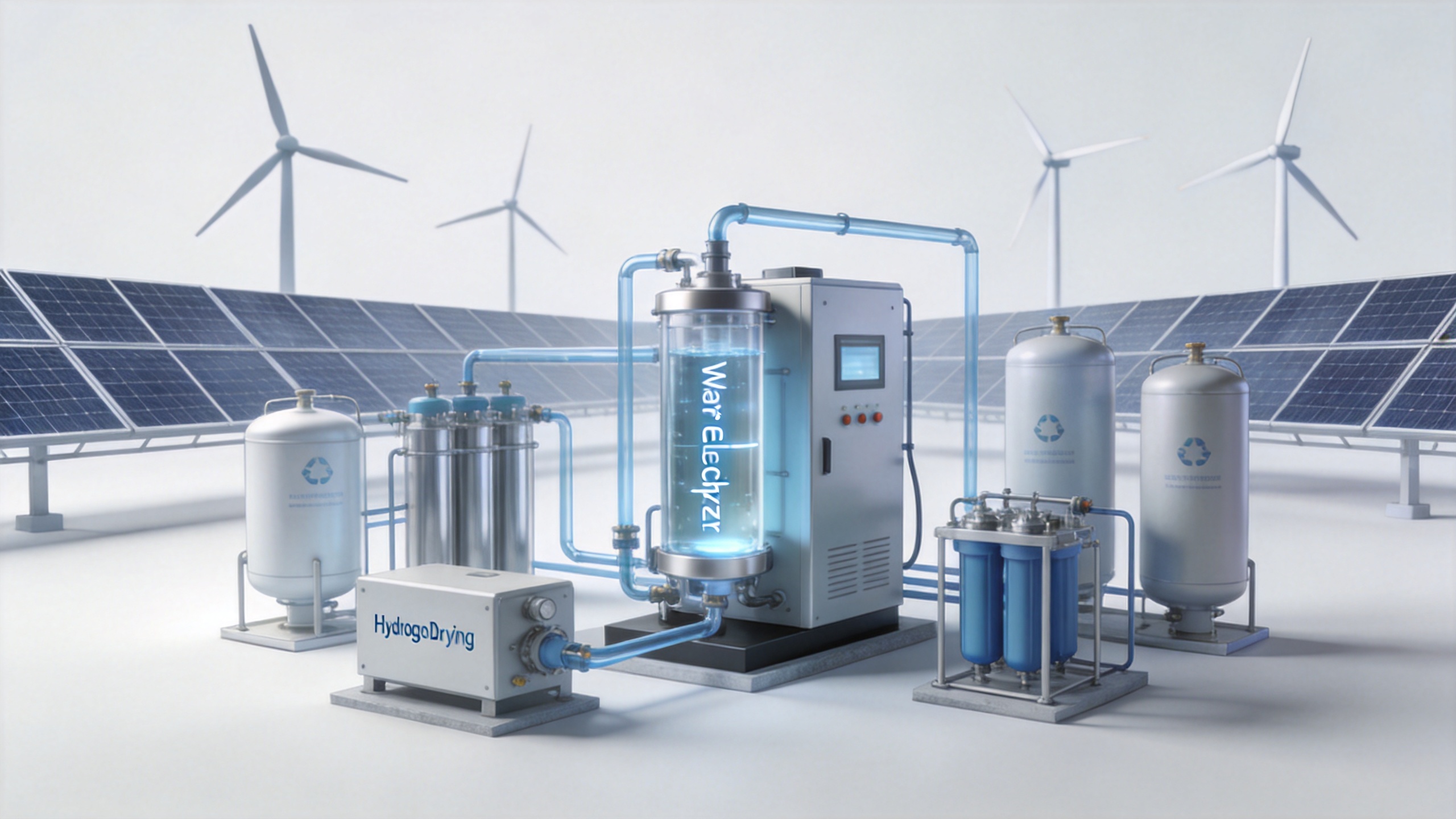
Core equipment in a green hydrogen system
A complete green hydrogen production process usually includes more than the stack. Typical blocks are renewable-power interconnection, transformers and rectifiers, water-treatment equipment, electrolyzer modules, gas-liquid separation, drying and purification equipment, hydrogen analysis, controls, safety systems, and downstream compression or storage. The balance of plant often determines whether a concept can operate smoothly at a real site.
Controls are especially important when power is variable. They coordinate starts, stops, ramping, alarms, temperature management, and gas-quality checks. Buyers should ask how the system behaves at partial load and during planned cycling, rather than looking only at a nameplate output.
How renewable power changes system design
Renewable power is the defining input in the green hydrogen production process, and it brings a design challenge: generation may not match the desired hydrogen-production schedule. A solar-led site may have strong daytime output; a wind-led site may have a different pattern. Engineers therefore evaluate available energy, curtailment opportunity, connection limits, power quality, and the operating window of the electrolyzer.
This is why a useful feasibility study links energy data to hydrogen demand. It should model when electricity is available, how the electrolyzer will respond, what auxiliary loads consume, and how much storage bridges the gap between production and use. The answer is a system configuration, not merely an electrolyzer selection.
Practical questions to ask before specifying equipment
- What renewable-energy source will supply the green hydrogen production process, and how will its origin be documented?
- What hydrogen output, pressure, purity, and delivery schedule does the downstream application require?
- What water source is available, and what treatment train is needed?
- How frequently will the electrolyzer start, stop, or operate at partial load?
- What storage, compression, ventilation, detection, and safety systems belong inside the project boundary?
- Which performance figures are measured at defined conditions, and which require site validation?
Answering these questions early prevents a common planning error: sizing the stack first and discovering later that power, water, gas handling, or controls set the real constraint.
Why the process matters for B2B project planning
For B2B decision-makers, the green hydrogen production process is both a technical pathway and a project-integration exercise. The target should be a transparent chain from renewable electricity to usable hydrogen, with assumptions visible at every interface. That approach makes it easier to compare options, identify missing infrastructure, and prepare a realistic procurement scope.
Green hydrogen can support clean-energy and storage strategies when the full system is designed around the site. Begin with the renewable-power profile and the hydrogen use case, then build the electrolyzer, conditioning, and storage scope around those facts. This keeps the green hydrogen production process grounded in engineering decisions that can be checked and refined.
Frequently Asked Questions
Is electrolysis the only green hydrogen production process?
Water electrolysis powered by renewable electricity is the common meaning of the term. Other hydrogen-production routes exist, but their classification depends on the feedstock and energy source used.
How much electricity does the green hydrogen production process use?
The theoretical minimum is about 39.4 kWh per kilogram of hydrogen. Actual system demand is higher and varies with technology, auxiliaries, operating conditions, and project design; early estimates often use a range around 50–55 kWh/kg as an engineering reference.
Can renewable power variability be managed?
Yes, but it must be addressed in the design. Controls, operating strategy, power infrastructure, and hydrogen storage all influence how a system handles variable renewable supply.