
 EN

Hydrogen vs Battery Storage for Long-Duration Energy Projects
For project teams planning renewable energy storage systems, the right question is rarely “hydrogen or batteries?” in isolation. It is whether the project needs efficient daily cycling, multi-day resilience, seasonal energy shifting, or a combination of all three. Hydrogen solar energy storage and battery energy storage solve different parts of that problem, so a credible comparison starts with the duty cycle rather than a headline efficiency number.
From a B2B project-evaluation perspective, batteries are usually strongest where electricity must be returned quickly and often. Hydrogen becomes more relevant when surplus renewable power must be carried across longer gaps and the energy capacity must grow without proportionally expanding the power-conversion equipment. The most practical outcome for many sites is a hybrid architecture, not a winner-takes-all choice.
Start With the Storage Duration and Dispatch Pattern for Hydrogen Solar Energy Storage
Long-duration energy storage is commonly discussed as storage that can discharge for eight hours or more. That definition is useful, but it is still too broad for procurement. A four-hour evening peak, a 24-hour weather event, and a week of low renewable output place very different demands on a system.
- Batteries: A strong fit for frequent, high-efficiency cycling, peak shaving, ramp control, and intraday solar shifting.
- Hydrogen: A potential fit for multi-day or longer energy reserves, low-frequency contingency support, and projects with large volumes of otherwise curtailed renewable generation.
- Hybrid systems: Use batteries for rapid response and hydrogen for the long tail of energy adequacy.
For hydrogen solar energy storage, quantify both the expected discharge hours and the number of consecutive low-generation days. This prevents a project team from applying a daily-cycling battery benchmark to a reserve-energy requirement that has a different value proposition.
In a hydrogen solar energy storage project, surplus photovoltaic or wind electricity supplies an electrolyser, hydrogen is stored, and a fuel cell or other conversion pathway can later provide electricity. This chain adds equipment and conversion steps, but it separates the energy reservoir from the electrical power block. That separation matters when a project needs substantially more stored energy without simply duplicating a battery container fleet.
Efficiency Favors Batteries, but Hydrogen Solar Energy Storage Changes the Duration Equation
Round-trip efficiency is a central comparison metric. Lithium-ion battery systems commonly retain a much larger share of the electricity that enters them than a power-to-hydrogen-to-power route. A published regenerative-hydrogen comparison used roughly 30% round-trip efficiency for a reference hydrogen system and cited about 75–90% for lithium-ion batteries; actual performance depends on the electrolyser, storage method, compression or conditioning, fuel cell, auxiliaries, and operating point.
That gap means a battery is generally the better choice when every megawatt-hour of renewable generation is scarce and the asset will cycle often. Yet efficiency does not decide every long-duration project. If low-cost surplus power would otherwise be curtailed, the project may value a storable chemical energy reserve more than maximum energy recovery. Storing hydrogen gas can also support energy availability over longer intervals, whereas the economics of a battery installation can become more sensitive as duration rises.
Compare Footprint, Scaling, and Site Constraints in Hydrogen Solar Energy Storage
Battery systems are modular and comparatively direct to deploy for many grid-support applications. However, as required discharge duration expands, the project adds more battery energy capacity alongside thermal management, controls, safety systems, and replacement planning. Hydrogen projects add their own site requirements: an electrolyser, storage equipment, balance-of-plant components, ventilation and detection design, and a conversion asset for electrical output.
The advantage of storing hydrogen gas is not that every site becomes simpler. It is that power and energy capacity can be scaled with different levers. A developer can size the electrolyser and power-generation block to the expected charge and dispatch rate, then evaluate storage capacity separately against the desired reserve period. This approach deserves particular attention where land, delivery logistics, renewable curtailment, or resilience requirements make multi-day storage a design objective.
A Hydrogen Solar Energy Storage vs Battery Project Comparison Matrix
| Decision factor | Battery storage | Hydrogen storage | What to test in the project model |
|---|---|---|---|
| Typical operating role | Fast response and frequent daily cycles | Longer-duration reserve and renewable-energy shifting | Hourly and multi-day dispatch scenarios |
| Round-trip efficiency | Generally higher | Generally lower due to conversion stages | Delivered-energy value, not only input energy |
| Energy-duration scaling | Additional duration typically means more battery capacity | Storage quantity can be assessed separately from power conversion | Cost curve from daily to multi-day duration |
| Response speed | Well suited to rapid electrical response | Depends on the conversion system and operating mode | Ramp-rate and outage-response requirements |
| Engineering focus | Controls, thermal management, fire protection, lifecycle planning | Hydrogen handling, storage pathway, detection, ventilation, and process integration | Permitting, safety case, operations capability |
For each case, calculate the levelized cost of delivered energy at the required duration. Hydrogen solar energy storage should be modelled with electricity supply, conversion losses, storage conditions, and reconversion duty explicitly separated; batteries should be modelled with cycle rate, usable capacity, degradation, augmentation, and replacement assumptions. A common spreadsheet that applies the same reliability target to both options is more useful than a technology-only comparison.
When Hydrogen Solar Energy Storage Is a Better Candidate
Hydrogen solar energy storage should enter the shortlist when the project has a recurring surplus-renewable window, needs energy availability beyond a daily cycle, and can support the associated process and safety engineering. It is especially worth screening when resilience is measured in days rather than hours, when curtailment is material, or when the stored hydrogen may have value in more than one energy use case.
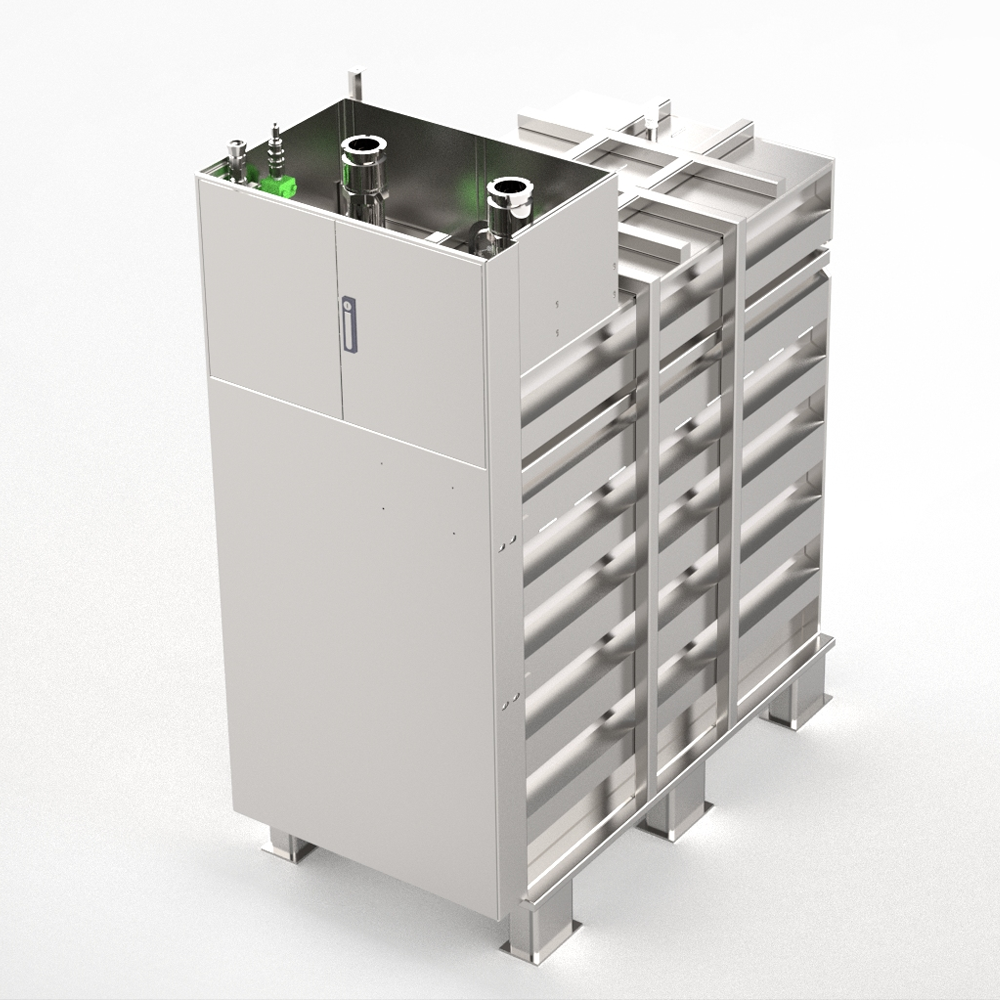
For example, teams assessing an integrated architecture can examine a Hydrogen microgrid integrated solution as a starting point for discussing interfaces between renewable generation, hydrogen production, storage, and local loads. For projects where the storage block is a key design question, a Mega hydrogen storage unit can help frame the physical-storage workstream. Those links identify relevant product categories; final sizing and performance should be verified against the project’s load study and engineering specifications.
Use a Hybrid Design When Hydrogen Solar Energy Storage Meets a Two-Timescale Load
A useful decision rule for hydrogen solar energy storage is to map the load into a fast layer and a long layer. Batteries can address seconds-to-hours variability and daily peak shifting, while hydrogen can be evaluated for rare but consequential multi-day events. This avoids oversizing a single technology to do every job poorly.
- Build an hourly renewable-generation and load model for at least one representative year.
- Identify the duration, frequency, and power level of deficit events.
- Price curtailed energy separately from purchased energy.
- Model battery degradation and replacement assumptions alongside hydrogen equipment availability and maintenance.
- Review safety, permitting, water, grid interconnection, and operating-staff requirements before selecting a storage pathway.
Also define what “available” means during a prolonged event. If the purpose of hydrogen solar energy storage is emergency continuity, test start-up time, minimum reserve, maintenance windows, and the priority loads that the system must serve. If the purpose is renewable optimization, test the value of avoided curtailment and the frequency with which stored energy is actually dispatched. These scenarios often lead to a hybrid design even when one technology appears cheaper on a simple installed-cost basis.
Conclusion: Select Hydrogen Solar Energy Storage by Service Requirement
Batteries usually lead when the project needs high efficiency and frequent short-to-medium-duration cycling. Hydrogen solar energy storage becomes more compelling when the project must preserve renewable energy for much longer periods, treat energy capacity and power capacity as separate design choices, or build a resilient reserve around otherwise curtailed generation. For many renewable energy storage systems, a coordinated battery-and-hydrogen design can assign each technology to the service it is better suited to perform.