
 EN

Hydrogen Storage Technologies: A Map of Options for Energy Projects
For an energy project team, choosing among hydrogen storage technologies is not a matter of selecting a vessel first. It is a matter of defining the duty cycle, site constraints, safety boundaries, and downstream use of the hydrogen. The same route can be sensible in one project and poorly matched in another. A useful starting point is to separate the major options—compressed gas, liquid hydrogen, and solid-state storage—then test each one against the operating envelope of the project.
From a B2B procurement perspective, hydrogen storage technologies should be compared as system choices. That means looking beyond nominal storage capacity to compression or cooling requirements, thermal connections, refueling or discharge behavior, maintenance access, permitting, and how the storage block connects to production, power conversion, and controls.
Start with the project boundary, not the storage hardware
Before comparing hydrogen storage technologies, document four project conditions: how much hydrogen must be held, how quickly it must be charged and discharged, where the system will operate, and what equipment sits on either side of storage. A renewable-energy project with intermittent production has a different profile from a facility that requires predictable backup power or an industrial site that receives hydrogen in batches.
Hydrogen has relatively low volumetric energy density, so delivery and storage often influence both the physical layout and energy balance of a project. That is why a route selection should begin with usable hydrogen demand over time rather than with a single capacity figure. Include peak demand, average demand, expected idle periods, startup needs, ambient conditions, and available electrical or thermal utilities.
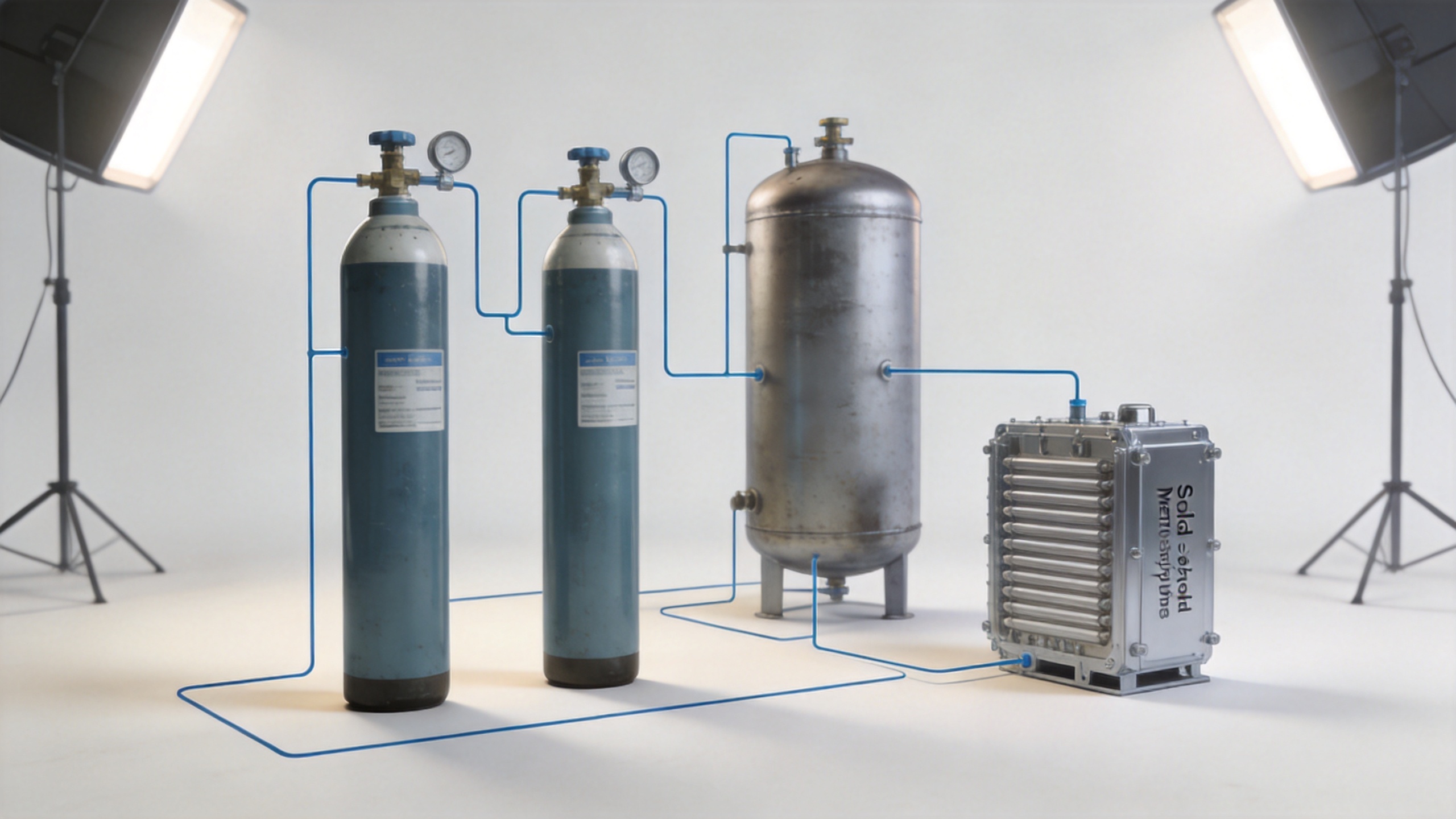
- Production connection: Is hydrogen generated continuously, intermittently, or delivered from outside the site?
- Use connection: Does the load require steady flow, short high-flow events, or long-duration reserve capacity?
- Site connection: What space, ventilation, access, power, and thermal-management provisions are available?
- Operating connection: Who will monitor the system, and what response procedures are realistic for the site?
More accurately, the appropriate route depends on the full operating envelope. Comparing equipment before these conditions are agreed can create a technically neat but commercially weak shortlist.
A practical map of the main hydrogen storage technologies
The main hydrogen storage technologies can be mapped by how hydrogen is contained: as a compressed gas, as a cryogenic liquid, or within a material system. Hybrid approaches also exist, but the three categories provide a useful first screen for energy projects.
| Route | What the project must accommodate | Typical evaluation focus |
|---|---|---|
| Compressed gaseous hydrogen | High-pressure equipment, compression energy, vessel arrangement, safety distances | Pressure rating, compression duty, footprint, delivery pattern, inspection plan |
| Liquid hydrogen | Cryogenic storage and transfer systems; liquid hydrogen is maintained near -253°C | Throughput, boil-off management, cryogenic operations, logistics, insulation |
| Solid-state hydrogen storage | A defined storage material plus its charging, discharge, and thermal operating window | Material behavior, heat transfer, cycle profile, integration, service requirements |
Compressed storage is often assessed where modularity and established high-pressure practices fit the project. Liquid storage may merit evaluation when volume and throughput requirements can justify cryogenic infrastructure. Solid-state hydrogen storage is different: it must be assessed as a specific material-and-system combination, not as one uniform technology category.
Where solid-state storage changes the decision
The solid-state branch of hydrogen storage technologies can be relevant when a project team is exploring a contained storage approach with a defined material system and controlled operating conditions. The key question is not whether solid-state storage is inherently preferable. The question is whether the material’s charge and discharge behavior, thermal requirements, response time, and system connections align with the intended duty cycle.
Some material systems may require thermal input or carefully managed heat removal during operation. Published reviews also note that operating conditions can vary significantly by material, with some systems requiring elevated release temperatures. Procurement teams should therefore ask for the applicable operating window, the test conditions behind any performance statement, and the expected behavior during startup, partial load, and extended standby.
For projects considering this route, a Medium hydrogen storage unit can be a useful discussion point for defining the required storage scale and connections. The product link should not replace technical due diligence; it provides a concrete starting point for aligning the application, storage block, and system documentation.
Use a route-selection sequence instead of a feature checklist
A feature checklist can obscure trade-offs. A better process moves from project facts to route constraints and then to supplier evidence.
- Set the hydrogen profile. Convert the project plan into a charge/discharge schedule, including peaks, downtime, and expansion scenarios.
- Screen the physical boundary. Compare available footprint, site layout, ventilation, access routes, and the practical location of supporting equipment.
- Screen utility needs. Identify electric power for compression, cryogenic support where relevant, and thermal utilities for material-based storage systems.
- Check control and safety connections. Define monitoring points, shutdown logic, detection arrangements, and how the storage block communicates with the broader energy system.
- Compare total operating assumptions. Request a transparent list of equipment, utilities, maintenance tasks, and assumptions behind any cost or efficiency discussion.
This sequence helps teams compare hydrogen storage technologies on the same basis. If a route needs a utility or operating procedure that the site cannot support, its theoretical merit may have limited project value.
Questions to put to a supplier before technical alignment
Early supplier conversations are more productive when the project team asks for evidence that matches the intended application. Technical targets are commonly organized by use case, so the evaluation criteria should be application-specific rather than borrowed from a different sector.
- What are the stated pressure and temperature boundaries for charging, holding, and discharge?
- Which capacity, flow, or cycle figures are measured values, and under what test conditions?
- What electrical and thermal utilities are required at normal operation and startup?
- What site-side connections, controls, ventilation, and emergency procedures must be supplied by the project?
- How does the design behave during partial load, planned standby, and a change in production availability?
- What inspection, service, and replacement activities should be included in the operating plan?
- Which documents define the boundary of supply and the assumptions used for system sizing?
These questions make the comparison traceable. They also reduce the risk of treating a broad technology label as a complete engineering specification.
Build a decision record that can survive the next design stage
Once the shortlist is clear, create a one-page route decision record for each option. Record the project need, the key operating assumptions, the connections that must be confirmed, and the evidence still required. This makes it easier for engineering, procurement, operations, and management to review the same decision boundary.
For hydrogen storage technologies, the goal is not to name a universal winner. It is to establish which route can be supported by the project’s real operating conditions and verified supplier information. Start with the hydrogen profile, test the site and utility constraints, and ask suppliers to document the conditions behind their proposal. That approach gives an energy project a clearer route map—and a more defensible basis for the next technical conversation.
Apply the map to your project questions
At concept stage, hydrogen storage technologies should be screened against production profile, intended load, and site limits before vessel layouts are compared. For variable renewable generation, hydrogen storage technologies should be tested against low-generation periods and the control plan. For backup power, hydrogen storage technologies should be assessed for availability at the required discharge point, start-up conditions, standby, and inspection. For industrial demand, hydrogen storage technologies should be compared against the real schedule, conditioning needs, and planned maintenance windows.
Space-constrained sites should consider hydrogen storage technologies together with supporting equipment, access, ventilation, and utilities. When electrical power is constrained, hydrogen storage technologies should be reviewed for auxiliary demand and, where relevant, cryogenic or thermal duties. Safety planning should assess hydrogen storage technologies alongside detection, isolation, operating procedures, and documented pressure and temperature boundaries.
For a possible expansion, hydrogen storage technologies should state the assumptions behind future capacity additions. When proposals arrive, hydrogen storage technologies should be compared on a common data sheet that places measured conditions beside each capacity or flow value. A commissioning plan should connect the selected hydrogen storage technologies to acceptance criteria that match the project duty cycle. This converts a market category into a traceable project decision.