 EN

How Anion Exchange Membrane Electrolyzers Work
An anion exchange membrane electrolyzer converts electrical energy and water into hydrogen and oxygen. For project teams evaluating hydrogen electrolysis systems, its appeal is easy to understand: the design combines a compact membrane-electrode assembly with alkaline electrochemistry, creating a route to hydrogen production that can use alkaline-compatible catalyst materials. The real value, however, comes from understanding what moves through the cell, what each component must do, and which operating conditions determine stable output.
The basic job of an AEM electrolyzer
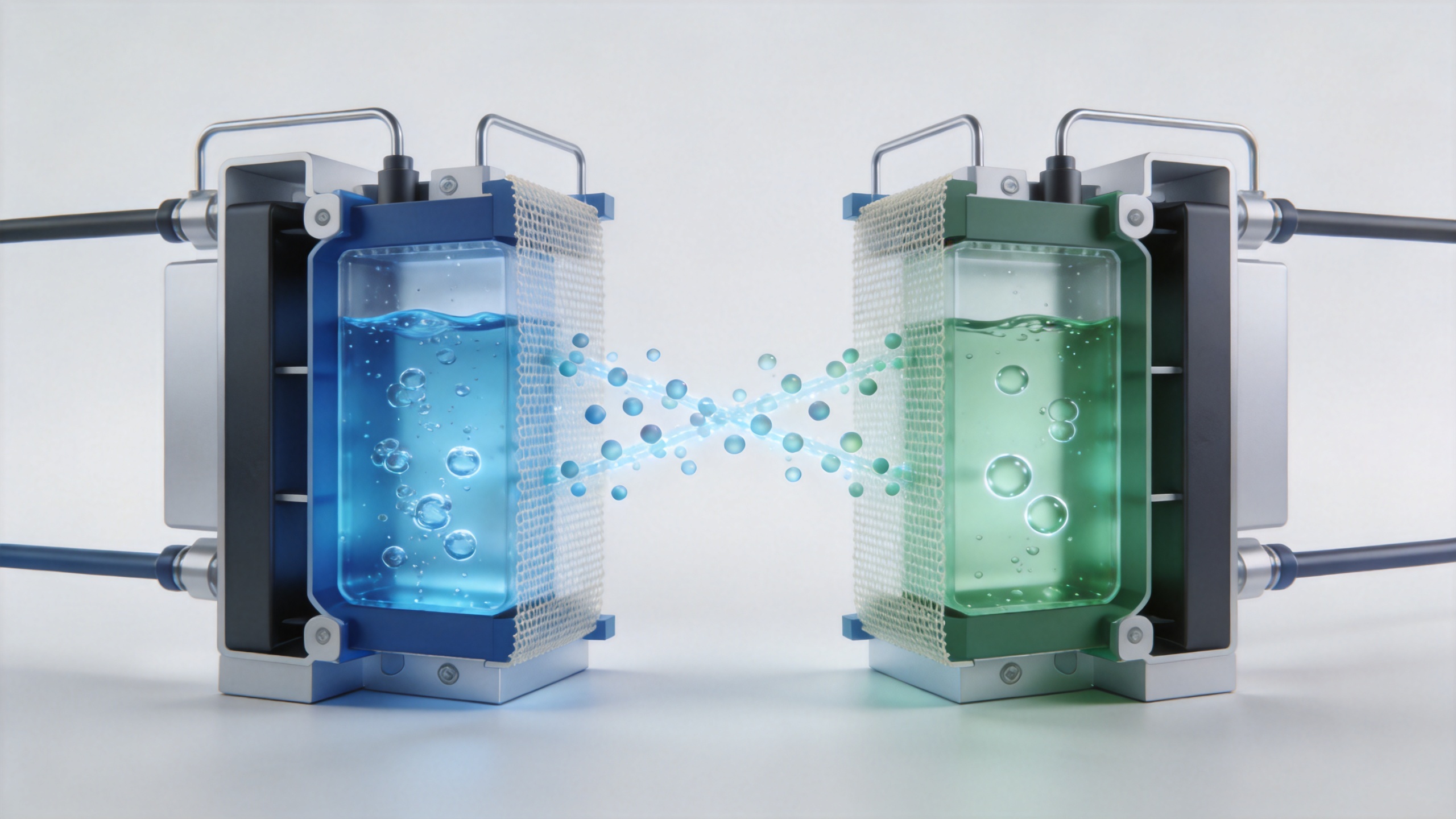
Every water electrolyzer performs the same overall reaction: 2H2O → 2H2 + O2. An anion exchange membrane electrolyzer does this by applying direct current across two electrodes separated by an anion-conducting polymer membrane. Water is split at the cathode to make hydrogen, while oxygen is produced at the anode. Instead of transporting protons across the membrane, the AEM system transports hydroxide ions (OH−).
That distinction defines the operating principle. The membrane must conduct ions efficiently while keeping the hydrogen and oxygen streams separated. The electrodes must make the two reactions proceed quickly enough at useful current density. Flow channels, porous transport layers, seals, current collectors, pumps, controls, and gas-liquid separation equipment must then support that electrochemical core without starving it of water or allowing gas crossover.
Step-by-step: what happens inside the cell
1. Hydrogen forms at the cathode
On the cathode side of an anion exchange membrane electrolyzer, electrons supplied by the power source drive the hydrogen evolution reaction:
2H2O + 2e− → H2 + 2OH−
Water reaches the catalyst layer, where it is reduced. Hydrogen gas leaves the electrode through the porous structure and is routed to downstream separation, drying, compression, storage, or use. The reaction also produces hydroxide ions. Those ions are the charge carriers that move through the membrane toward the anode.
2. Hydroxide ions cross the membrane
The polymer membrane is the defining part of an anion exchange membrane electrolyzer. Its fixed charged groups create pathways for OH− transport. At the same time, the membrane acts as a separator between the two gas environments. Efficient ion transport reduces resistive loss; effective separation helps limit hydrogen–oxygen crossover. Both jobs depend on membrane chemistry, thickness, hydration, compression, temperature, pressure balance, and the condition of the membrane-electrode interfaces.
3. Oxygen forms at the anode
At the anode, hydroxide ions give up electrons in the oxygen evolution reaction:
4OH− → O2 + 2H2O + 4e−
The released electrons travel through the external circuit back to the cathode, completing the electrical path. Oxygen and water are managed on the anode side. When the cathode and anode reactions are combined, the hydroxide ions cancel out, leaving the familiar overall water-splitting equation. This closed ion loop is the simplest way to visualize electrolyzer technology in an AEM cell: electrons travel through wires; hydroxide ions travel through the membrane; gases leave through separate flow paths.
The components that make the principle practical
A working anion exchange membrane electrolyzer is more than two catalysts and a membrane. Its membrane-electrode assembly (MEA) commonly includes the AEM, catalyst layers, and porous layers that distribute water, remove gases, and carry current. Bipolar plates or current collectors distribute reactants and conduct electricity between cells in a stack. Gaskets and compression hardware preserve sealing and contact pressure.
Outside the stack, the balance of plant regulates water supply, recirculation where applicable, temperature, differential pressure, power conversion, safety monitoring, and gas treatment. At system level, engineering choices must keep local conditions inside a range that supports membrane hydration and reliable gas management. A design that performs well in a short laboratory test can still face challenges when scaling flow uniformity, thermal gradients, maintenance access, startup behavior, and long-duration durability.
Why alkaline chemistry matters
The alkaline environment of an anion exchange membrane electrolyzer can enable catalyst development around transition-metal materials, including nickel-based families, rather than limiting every catalyst choice to precious-metal families. That is an engineering opportunity, not an automatic system-level cost or performance guarantee. Catalyst activity, electrode architecture, membrane stability, manufacturing method, operating pressure, and expected service life all affect the final design decision.
Compared with conventional alkaline electrolysis, an AEM approach uses a solid polymer membrane and a closely integrated MEA, which can support compact stack construction. Compared with proton exchange membrane systems, it reverses the ion-transport direction and targets alkaline-compatible materials. These categories should be evaluated against the project’s hydrogen purity requirements, dynamic operating profile, power source, water treatment plan, target capacity, footprint, maintenance strategy, and safety case—not by a single headline metric.
Engineering considerations for hydrogen electrolysis systems
- Water quality and chemistry: Feedwater and any electrolyte strategy influence contamination control, catalyst behavior, and membrane health.
- Current density and voltage: Higher output is useful only when activation, ohmic, and mass-transport losses remain manageable.
- Temperature management: Temperature affects reaction kinetics, membrane conductivity, gas solubility, and component stress.
- Pressure balance: Differential pressure across the membrane must be controlled to protect gas separation and mechanical integrity.
- Gas handling: Hydrogen and oxygen require dedicated separation, monitoring, venting, and safety measures.
- Stack-to-system integration: Power electronics, water treatment, storage, and controls determine whether stack performance becomes dependable hydrogen supply.
For capacity planning, it is useful to compare a smaller 2.5W-10KW system range with a larger 100KW-500KW system range in the context of site load, available renewable power, storage requirements, and commissioning constraints. The product names identify available system ranges; a technical review should confirm the applicable configuration and specifications before selection.
A practical way to assess an AEM electrolyzer
Start by mapping the energy source and hydrogen demand profile. Then ask how the anion exchange membrane electrolyzer will be supplied with water, how it will respond to load changes, where hydrogen and oxygen will go, and how the project will monitor purity and safety. Request test conditions alongside reported performance data: temperature, pressure, feed chemistry, current density, run duration, and degradation criteria all change how a result should be interpreted.
For early-stage teams, the key lesson is straightforward. An AEM electrolyzer works because a membrane selectively carries hydroxide ions while electrochemical reactions make hydrogen at the cathode and oxygen at the anode. Turning that principle into reliable clean-hydrogen production requires careful integration of the MEA, stack, water loop, thermal controls, electrical supply, and gas-handling equipment. Evaluating those interfaces together gives a more useful basis for selecting hydrogen electrolysis systems than comparing one component in isolation.